Sanity vs dotsy: which one does your website need?
Sanity is a content backend for developers: it stores your content and gives you an editing app, and a developer builds and hosts the website that shows it. dotsy is the website itself: hosting, an editor on the real page, SEO, forms and analytics in one place, run by you and your AI (Claude, ChatGPT or Cursor). If you have an engineering team feeding a website and an app from one content model, Sanity fits. If you want a great website live this week without a developer, choose dotsy.
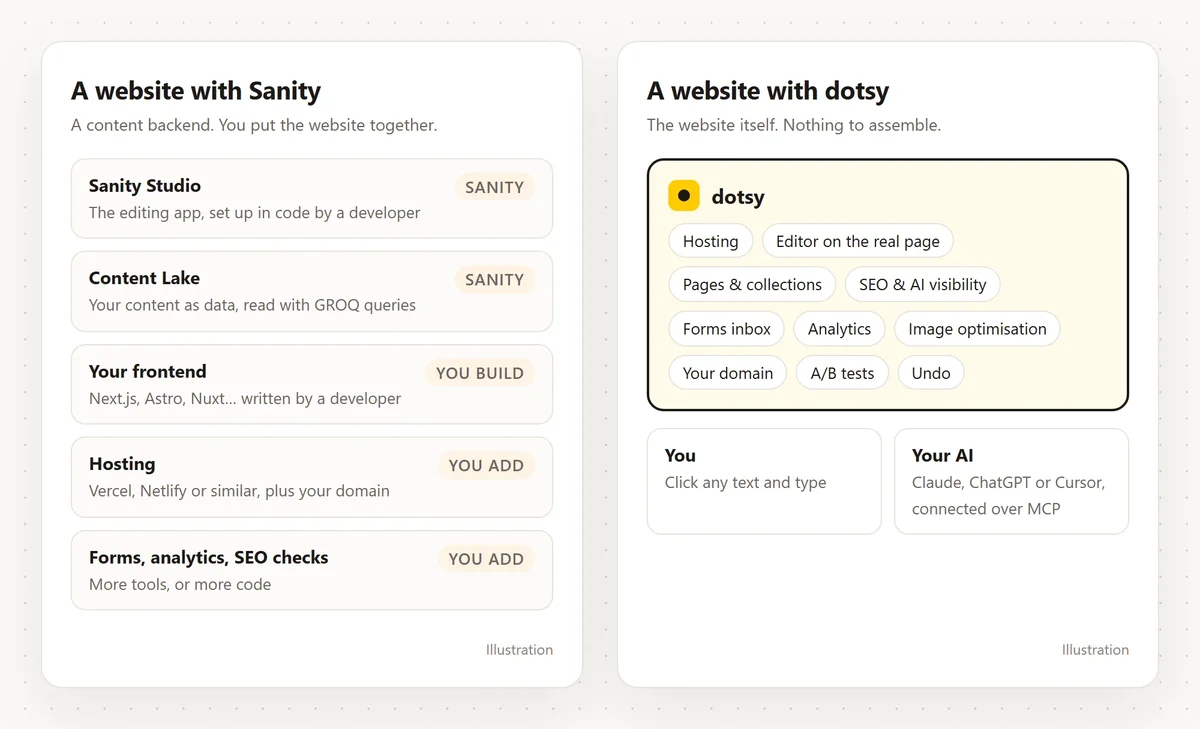
Both are good products. They solve different problems, which is why people who compare them often end up talking past each other. Here is what each one is, side by side.
What is Sanity?
Sanity calls itself a Content Operating System. It has three main parts:
- Content Lake: a hosted database for your content, which you read with Sanity's query language, GROQ.
- Sanity Studio: an open-source editing app. A developer defines the content types in code, then deploys it to a
*.sanity.studioaddress or their own hosting. - APIs and SDKs that any website, app or device can read content from.
Sanity does not serve your website. You build one with a framework such as Next.js, Astro or Nuxt (Sanity's quickstarts start there) and host it yourself, usually on Vercel or Netlify. The upside is total freedom: the same content can feed a website, a mobile app, a shop and an email at once.
What is dotsy?
dotsy is a web platform: it hosts your site on Cloudflare's network and gives you everything around it. You click any text on your real page and type, or ask your AI to do it. You can build a new site with your AI, or import an existing one from its URL, and publish when you're happy. There's no separate frontend to build, host or update.
Every plan includes forms with an inbox, cookie-free analytics, image optimisation, redirects, a sitemap and schema markup, AI visibility (an llms.txt file and reports on AI crawlers), draft previews, version history and undo.
How do they use AI?
Both take AI seriously, in different places.
Sanity's AI works on your content. Its MCP server lets coding agents such as Claude or Cursor manage content and schemas. Content Agent is a chat assistant for editors. Agent Actions generate, translate and transform documents. Sanity Context gives your own AI apps read-only access to your content. A developer still owns the website that shows it.
dotsy's AI works on the whole site. Connect dotsy to Claude, ChatGPT or Cursor over MCP (or use the CLI or HTTP API), and your AI can build pages, import a site, fix SEO issues, set up forms, run A/B tests, connect your domain and publish. You stay in charge:
- AI access per site: read only, drafts only (a person publishes), drafts and publish, or full access.
- Rules and guidelines: how the site should look, sound and rank. dotsy checks changed pages against them when an agent publishes.
- Activity log: every change shows whether a person or an agent made it, with per-change undo.
Setup takes a minute: How do I connect dotsy to Claude, ChatGPT or Cursor?
How long does it take to get a site live?
With Sanity: define your content types in code, deploy Studio, build the frontend, connect previews and rebuild hooks, host it, then point your domain at it. That's days to weeks of developer time, depending on the site.
With dotsy: ask your AI to build the site (or import your current one), check the draft, publish. It goes live on a free yoursite.dotsy.site address in minutes, and you can add your own domain on a paid plan: How do I connect my own domain?
What does each one cost?
Sanity charges per seat. dotsy charges per workspace, with unlimited users on every plan.
| Sanity | dotsy | |
|---|---|---|
| Free plan | $0: up to 20 seats, 10k documents, public datasets only | $0: 20 websites, 50k page views a month, on yoursite.dotsy.site |
| First paid plan | Growth: $15 per seat a month (up to 50 seats), 25k documents | Core: $15 a month for the whole workspace, 100 websites, 200k page views, 3 of your own domains |
| Bigger plans | Enterprise: custom price | Studio $39, Agency $99 (1,000 websites) |
| Website hosting | Not included: you host the frontend | Included |
| Developer time | Needed to build and maintain the frontend | Not needed |
Example: a team of five on Sanity Growth pays $75 a month for seats, before hosting and developer time. The same team on dotsy Core pays $15 a month, hosting included. Sanity's numbers are from sanity.io/pricing on 9 November 2026; ours are on dotsy.ai/pricing.
Sanity vs dotsy at a glance
| Sanity | dotsy | |
|---|---|---|
| What it is | Content backend + editing app | The whole website platform |
| Who builds the website | A developer | You or your AI |
| Hosting | Bring your own | Included, on Cloudflare |
| Editing | Studio forms, plus visual editing once a developer connects your frontend | Click and type on the real page, or ask your AI |
| AI | On your content: MCP server, Content Agent, Agent Actions | On the whole site, over MCP, with access levels, rules and an activity log |
| Forms, analytics, SEO checks | Build them or add other tools | Built in |
| Import an existing site | Import tools plus developer work | From its URL |
| Same content in a mobile app | Yes, that's its strength | No, dotsy serves websites |
| Pricing | Per seat | Per workspace, unlimited users |
When is Sanity the better choice?
Pick Sanity when:
- One content model has to feed a website, a mobile app, a shop and more.
- Your developers want full control over the frontend framework and the editing app.
- Your editors need real-time co-editing, comments, tasks and scheduled releases.
- You need enterprise features such as SAML single sign-on, custom roles and an uptime SLA.
- Your site is in many languages today. Sites in more than one language are planned on dotsy, not shipped yet.
When is dotsy the better choice?
Pick dotsy when:
- You want a website live this week, without hiring a developer or keeping one on call.
- You already work with Claude, ChatGPT or Cursor and want your AI to build and run the site, within rules you set.
- You want hosting, forms, analytics, SEO and AI visibility in one place instead of stitching tools together.
- You're an agency or a team running many sites: you pay per workspace, not per person.
- You're moving an existing site and want to start from what's already there: How do I move my existing website to dotsy?
Questions people ask
Is dotsy a headless CMS like Sanity?
No. dotsy has pages and collections (blog posts, help articles, product lists) that you edit, but it serves them as your website rather than as content for other apps to fetch. If you need the same content in a mobile app, Sanity is the better fit.
Can I move my Sanity website to dotsy?
Yes. Import your live site from its URL and dotsy copies the published pages, which you can then edit and publish. Sanity's structured content isn't moved field by field, so plan a check of your blog and other lists after the import.
Do I need a developer for dotsy?
No. You can edit by clicking on the page or by asking your AI. Developers can still use the CLI and HTTP API when they want to.
Can my AI publish without me?
Only if you allow it. Each site has an AI access setting: with Drafts only, nothing goes live until a person publishes. dotsy also checks an agent's changes against the rules you set for the site when it publishes.
Want to see the difference for yourself? Connect your AI and ask it to build a page: How do I connect dotsy to Claude, ChatGPT or Cursor? It's free to start, no card needed. Comparing other options too? Read Storyblok vs dotsy, or, if your AI already built the site, Claude built your website. How do you put it online?